The uplifting story of how PCEP dancers have become national force

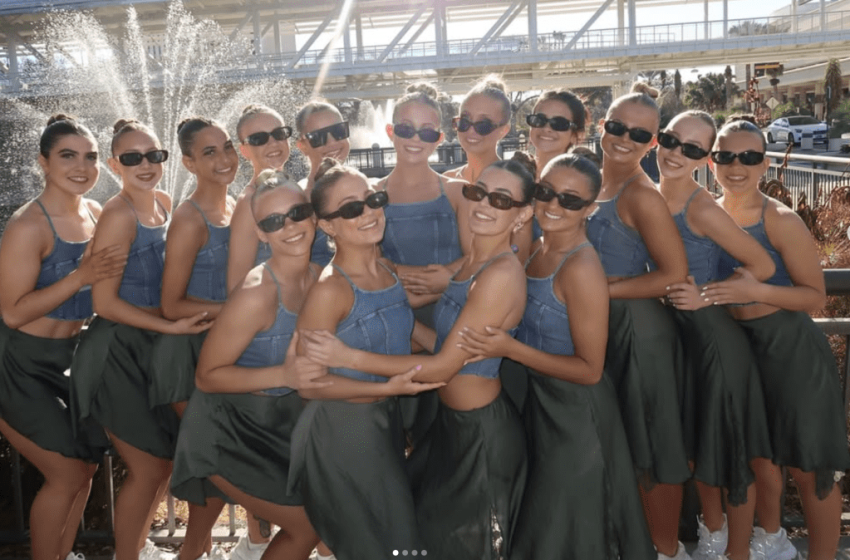
Members of the PCEP Varsity Dance Team are pictured during their recent trip to Orlando, where they captured their third straight National Championship.
The pressure is immense for the 15 members of the P-CEP Varsity Dance Team, who spin and flip and flow together with perfect synchronization, like the parts inside a Rolex watch — knowing one minor misstep could cost their team a shot at a national championship.
Only a common bond glued together by love, mutual respect and dedication keeps the team ticking flawlessly.
Earlier this month, the PCEP Varsity Dance Team earned its third consecutive national championship in Orlando, Florida, while performing a near-flawless two-minute routine to the song “Stand By Me” — an anthem, of sorts, for their unbreakable sisterhood.
The team’s two coaches — Maria Lloyd-Cytacki (who started the team in 2010) and Elisa Sutherland — could barely hold back tears of joy while joined by team members Avery Nimmerguth, Elliana Zopf, Grace Bec and Kenzie Wegner for a recent interview with Social House News.
As nice as they are talented
“What gets us the most,” said Lloyd-Cytacki, “is not only how talented these girls are — they blow us away every day with their talent and dedication — but how everyone, including the most talented dancer in the room, is working hard to improve every single practice.

“Not only that, but they are the nicest kids. They’re cheering for everyone else during competitions. For instance, after the national championships, Avery (Nimmerguth) and a girl from Macomb Dakota (which finished second in the country) ran over to each other and hugged.
“We have other teams’ coaches coming up to us all the time and telling us PCEP dancers are so kind. That’s is the best compliment you can get.”
“Maria and I both have full-time jobs and lives outside of dance, but our favorite six hours of the week are the time we get to spend at practice with this amazing team,” Sutherland added. “We are so, so proud of them and the amazing performers and human beings they are.”
Like clockwork
Every season starts in June with auditions and a visit in August by a Minnesota-based company that the team flies in to suggest a song and choreography for that season’s competitions.

“Our auditions in June are the best and worst weekend of the year for Elisa and I,” Lloyd-Cytacki said. “There are some incredibly talented dancers who don’t make the team — and we provide them with feedback so they can work on what they need to improve on if they tryout the following year.”
Lloyd-Cytacki and Sutherland said multiple dancers have been cut one year and made the team the next — a testament to the dancers’ resilience and desire to be a part of the team.
Once the song and choreography are chosen, it’s time for the grind of perfecting the performance … but it’s a happy grind, all four dancers who attended the interview agreed.
“For us, the dedication part of it is the big thing we preach every practice,” Wegner said. “No matter what happens before practice, we come into this space (The Michigan Dance Alliance studio in Canton) and give 100% of our effort, even if it’s a day when we’re not feeling 100%. We’re in an environment where everyone picks everyone else up because they want the same thing as you.”
‘We’re like a family’
“Dedication is a big part of this team,” Zopf added. “Some days are longer than others, for sure, but we’re all there for each other at the end of the day and the rewards are so worth all the hard work. We’re like a big family.”
“We push ourselves and our teammates until there is nothing left to give,” Bec said.

When a non-dancer like myself watches a PCEP routine unfold with flawless precision, a couple of questions emerge: 1. How do dancers complete a 50-spin pirouette, then regroup in a micro-second to continue the routine?; and 2. How do the dancers remember every step of a complicated two-minute routine?
“When we’re turning (with the speed of a top while performing a pirouette) we whip our heads around ahead of our bodies so our heads don’t follow our bodies,” Nimmerguth revealed. “That way, you don’t get dizzy. I think we’re probably more thrown off when we do our flips.”
The path to perfection
Wegner eloquently described how the team learns the routine to a T over the stretch of several weeks until its first competition in November.
“I think it all comes down to repetition and small details,” said Wegner, who described herself as a “horrible turner” before she joined PCEP. “Every practice we take 30 minutes to walk through every step and every turn in the routine so that muscle memory takes over by the time we compete.
“National Championships are great, but the journey of getting to nationals is the most rewarding part of being on this team.”
Dance team member Cadance Toby confirmed that reaching perfection with a routine is a months-long process.
“Preparing for our jazz routine is something we start from the beginning of the season,” Toby said. “Making sure we’re all on the same page about the story of our routine is very important so we are able to have a cohesive understanding of the storyline. We also do lot of cleaning and nit-picking to make sure everything is perfect in the end product.”
Waiting is the hardest part
The moments immediately before and immediately after delivering state-, regional- and national-championship performances are the most nerve-wracking, the dancers and coaches agreed.
“Before we perform our routine at Nationals, we’ll meet at a practice floor and perform a half full-out of all our tricks and turns so we feel confident about what we’re about to put on,” Nimmerguth said. “After that, we unite, listen to our music, lay down on the ground in a circle and feel the music and each other. This grounds us and reminds us we’re all in this together.
“Next we get up, link arms and do our power pose — chest up, chin up — and listen to the music. The captains will give a pep talk and sometimes we pray, then we go on and do what we do best.”
Smallest details matter
Lloyd-Cytacki said the pressure on the dancers is off the charts, which makes their phenomenal performances all the more impressive.
“For instance, if one dancer is off on a turn — maybe off-center just a little — it throws the sync off and the judges will get you,” she explained. “It’s like a domino effect, too, because if your sync is off, it’s going to affect your spacing, so that is another point deduction.
“There are 10 categories worth 10 points each, so the little details matter.”

Once the routine is completed, there’s a moment to relax — but then comes the agonizing wait for the scores.
“After four years, I thought it would get easier (waiting for the scores),” Nimmerguth said, smiling. “But it doesn’t. I’m still a nervous wreck before the scores come in.
“Yes, our No. 1 goal is to do our personal best, but knowing how much work goes into it, we want to win, too.”
“Everybody handles the waiting in their own way,” Wegner said. “Some of us get super anxious. When this happens, a teammate or coach will tell you to, ‘Just breathe, we’re OK’. Others get a little goofy or silly; maybe start dancing off to the side. But in the end, we all know we’re in it together.”
‘Laughing and crying’
When the final scores were announced at this year’s Nationals, the reaction from her dancers was a mixture of laughing and crying, Lloyd-Cytacki said.
“Every emotion there is breaks through,” she said.
The team’s relative lack of recognition after winning three consecutive national championships is slightly bothersome to a point, the dancers shared, but it doesn’t dampen their amazing achievements.
“Those in the dance world, along with our families and friends, are our biggest cheerleaders because they know what we’ve put into this,” said Bec. “We’re not just going out there on the stage to look pretty. This is a sport and it’s hard. It’s something we love doing, too, so no one can take that away from us.”
And you know what they say about immense pressure: It turns carbon atoms into diamonds.
When it comes to the PCEP Varsity Dance Team, pressure turns hundreds of hours of practice, dedication and friendship into gold.
Ed Wright can be reached at 734-664-4657 or edwright@socialhousenews.com.